

Switch tools quickly with Pristy Connect
Table of Content
What is Pristy Connect for?
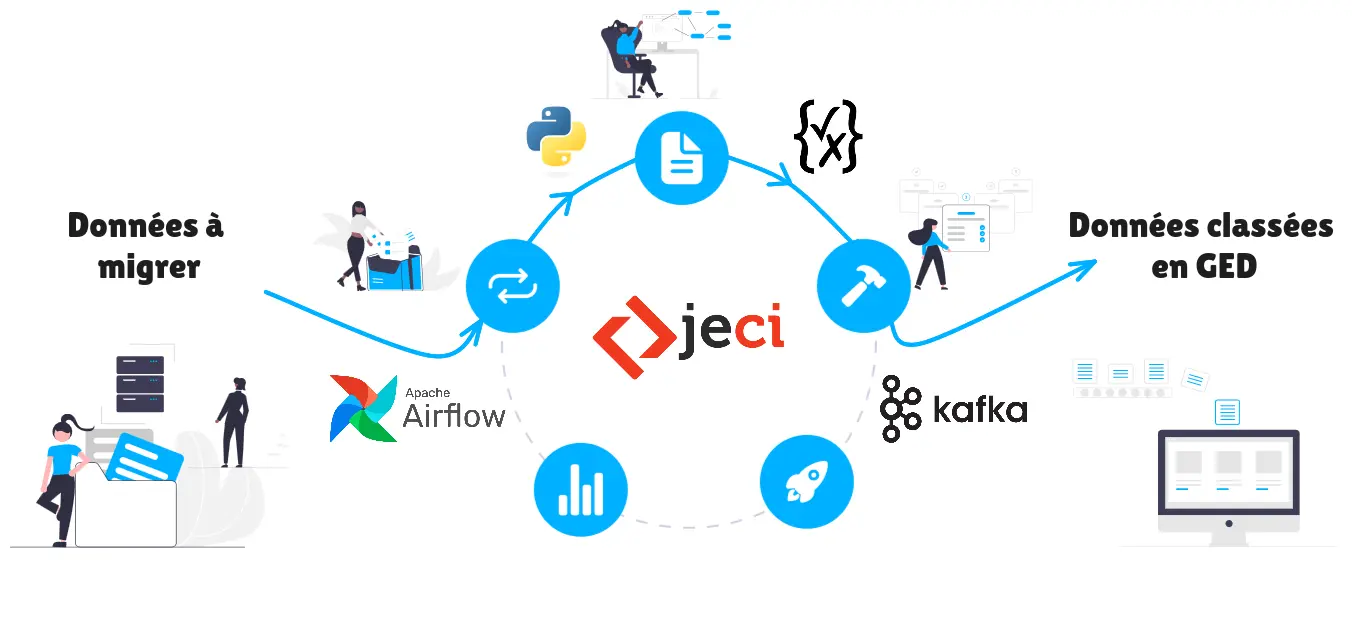
It enables bulk migration of documents or content in a minimum of time.
More specifically, it retrieves files and a file tree from a variety of sources (Alfresco, another EDM system, a standard file system), then reproduces the tree and metadata on another target (Alfresco, Pristy or another EDM system), either identically or in a transformed form.
This is known as an “ETL” tool, for extract-transform-load.
It can be used for data migration from an EDM system or a network drive, as well as for continuous synchronisation of data or documents coming from a business application.
The benefits of our service
A migration with no impact on the production server
Our injection system, while not necessarily asynchronous, works in two stages. The load on the server can therefore be tuned and adapted to your needs.
You can choose to prioritise injection time, and thus increase the load on the server, or conversely prioritise an injection with no impact on production, which may take longer but remains transparent to operations.
Handling interruptions
Thanks to Kafka1, we are able to resume the injection process if it has been interrupted. Whether the interruption is intentional or not, the queue is paused and picks up where it left off when the process restarts.
Easily adaptable
The technology we chose makes it quick and easy to adapt our tool to a specific need.
Using modular Python2 scripts that are simple to write (especially with the help of AI) allows clients to adapt the code to their needs themselves.
Not just for Alfresco
As Alfresco specialists, we developed this solution for that very need.
But this solution is not specific to Alfresco. It can be connected to or from other sources. You can migrate from Alfresco to Alfresco, but you could also imagine Alfresco to Nextcloud, SharePoint to Pristy (Alfresco), a file server to Pristy, and so on.
Video presentation
Find out how we use Pristy Connect to work with EDM content.
Prerequisites
Data assessment
An assessment to determine the state of the data, in particular to make sure the data is at least minimally structured: unstructured data cannot be migrated as is, or at the very least it must be possible to structure it, and therefore to enrich it.
Adapting the target
Example for Alfresco:
- the target tree must comply with Alfresco’s constraints, i.e. 2,000 nodes per directory, so 2,000 files or folders per directory, and
- the number of metadata fields should be limited, i.e. use 20 metadata fields per file rather than 40 or 50.
Resources to plan for
This depends on the load, the volume and the execution time frame
- Data must be able to move from one server to another, either through network mounts or network streams.
- If a large volume has to be processed within a short time frame, substantial server resources are needed, possibly several servers;
- conversely, if data arrives continuously but over a very long period, no additional specific resources are needed.
Compliance with interoperability regulations
As a reminder, the French General Interoperability Framework (Référentiel Général d’Interopérabilité, RGI) has been in force since “version 2.0 of the RGI was made official by the decree of 20 April 2016 (JORF no. 0095 of 22 April 2016, text no. 1).”
Definition of interoperability in the context of the RGI:
We will use Wikipedia’s definition for the RGI. The European Commission also defines what an interoperability framework should be: a European-level framework, the European Interoperability Framework (EIF), and a national interoperability framework for each Member State, the National Interoperability Framework (NIF) […]
“An interoperability framework is an agreed approach to interoperability for organisations that wish to work together towards the joint delivery of public services. Within its scope of applicability, it specifies a set of”
Thanks to this framework, you can be sure of getting your data back. Our solution provides a standard for classifying the retrieved data and injecting it, properly organised, into a new tool.
Learn more
Articles connexes
Définitions en rapport avec l'article
- ETL
- the generic name for data migration tools. It stands for Extract-transform-load.
- JSON Schema
- While JSON is probably the most popular format for exchanging data, JSON Schema is the vocabulary that enables JSON data consistency, validity, and interoperability at scale.[^Json]
- Airflow3
- an open source workflow management platform 4
- Kafka1
- open source project under the Apache License 2.0: “event streaming software for collecting, processing, storing and analysing data at scale”. 5
Notes de pas de page
Apache, Apache Kafka, and the Apache Kafka logo are registered trademarks or trademarks of The Apache Software Foundation in the U.S. and/or other countries. ↩︎ ↩︎
Python and PyCon are trademarks or registered trademarks of the Python Software Foundation. ↩︎
Apache, Apache Airflow, and the Apache Airflow logo are registered trademarks or trademarks of The Apache Software Foundation in the U.S. and/or other countries. ↩︎
Source: Apache Kafka website, https://kafka.apache.org/powered-by ↩︎